What a slipped or herniated disc means
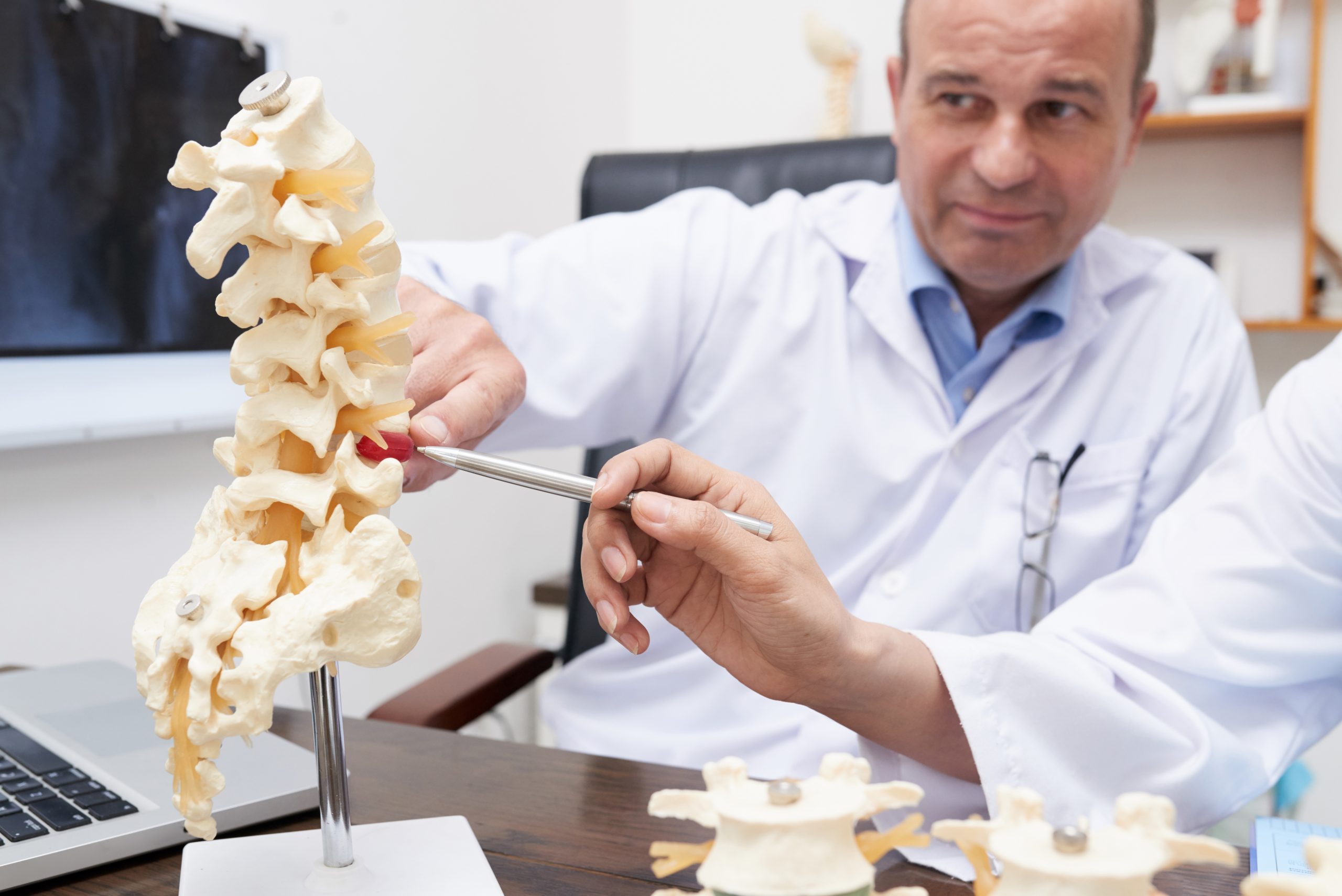
The spine is made of stacked bones (vertebrae). Between each pair sits a disc that works as a cushion and shock absorber. Each disc has a tough, flexible outer ring (the annulus) around a soft, jelly-like centre (the nucleus).1-4
Despite the name, a disc doesn’t usually “slip” out of place like a dislodged bone. In a herniated disc, part of the soft center is pushed through a tear or weak point in the outer ring.2,4 If it presses on a nearby nerve, it can cause symptoms. The disc material also releases chemical irritants that can inflame the nerve, so pressure is not the only factor.4 Age-related wear is the most common background, and a strain or injury can also play a part.2,4
Slipped disc symptoms by spinal level
Symptoms depend on where the disc is and how large the herniation is. If it isn’t pressing on a nerve, there might be low back ache or no pain at all. If it is, there may be pain, numbness or weakness in the area that nerve supplies.2
Lumbar (lower back) disc symptoms
Pressure on nerves that feed the sciatic nerve can cause pain, burning, tingling or numbness from the buttock into the leg, sometimes into the foot, usually on one side.2
Back pain without leg pain has many possible causes other than a herniated disc.5
Cervical (neck) disc symptoms
Nerve compression in the neck may cause dull or sharp neck pain, pain between the shoulder blades, pain travelling down the arm to the hand or fingers, or numbness and tingling in the shoulder or arm. Symptoms may change with neck position.2
Arm pain is the most common symptom of a compressed neck nerve root, followed by tingling.
Can a slipped disc improve without surgery?
Yes, in many people. Patient-education pages from neurosurgical and spine societies quote figures such as about 9 in 10 people improving2 and 80–90% of new or recent herniations improving without surgery.5
What non-surgical care may come before an operation
Non-surgical care is organized around goals rather than one fixed pathway. The clinician chooses what fits the situation.
Goal: settle pain and nerve irritation
Anti-inflammatory painkillers. Ibuprofen-type painkillers can help some people, with pharmacist advice on suitability.1
Epidural steroid injections are advised for acute and severe sciatica.3
Goal: keep moving and maintain function
Resting briefly is recommended if pain is very bad, then gradually building up gentle activity such as walking, swimming or yoga, as long as it doesn’t cause pain or make symptoms worse.1
Goal: rehabilitation and physiotherapy
A group exercise program is recommended for a flare-up of low back pain with or without sciatica. Manual therapy or psychological approaches should be considered only as part of a package that includes exercise.3
Goal: monitor and reassess
Repeat examination matters. Progression of an objective neurological finding at any point should prompt an MRI and referral to a spinal surgeon.9 If symptoms don’t improve, further tests such as MRI may be arranged.1
General health measures include staying active, lifting safely and not smoking.1
When might surgery be considered?
Most slipped discs don’t need surgery, but a specialist may discuss it in the situations below.1,2
Questions to ask the spine surgeon
Do my symptoms and examination findings match the scan?
Matching findings are central to the decision.3
What specific symptom or function is the operation intended to improve?
For a herniated lumbar disc, surgery mainly aims to relieve leg pain from a compressed nerve and is less effective for back pain.5
What alternatives are appropriate, and what are the risks of waiting in my case?
The answer differs if there is progressive weakness.6,7
What are the material risks and limitations of each option?
Ask for figures specific to your procedure and spinal level.
How will we measure progress and revisit the plan?
Repeat examination and reassessment are part of good care.8
Frequently asked questions
Can a slipped disc heal without surgery?
Many improve without surgery,1,2,4 and disc material can shrink over time, although how often varies widely between studies.9,10 Recovery isn’t guaranteed. About 20–30% of people with sciatica still have problems after one or two years.11
Does severe pain always mean surgery is needed?
No. NICE links surgery to non-surgical treatment not having improved pain or function, together with matching imaging.3 In the Dutch trial, most people assigned to conservative care did not need surgery.12
Is an MRI report enough to make the decision?
No. Disc findings are common in people without symptoms,13 and the imaging must match your symptoms and examination.3,8
When do numbness or weakness become urgent?
Seek emergency care for numbness around the bottom or genitals, bladder or bowel changes, or loss of feeling in one or both legs.1 Significant or worsening arm or leg weakness, or progressive neurological deficit, needs urgent evaluation.2 Persistent, spreading or worsening numbness or weakness should be assessed promptly.1,8
References
- NHS. Slipped disc. NHS website. Page last reviewed 24 April 2024. https://www.nhs.uk/conditions/slipped-disc/
- American Association of Neurological Surgeons (AANS). Herniated disc. Patient information (page modified July 2024). https://www.aans.org/patients/conditions-treatments/herniated-disc/
- National Institute for Health and Care Excellence (NICE). Low back pain and sciatica in over 16s: assessment and management (NG59). Published 30 November 2016; pharmacological recommendations for sciatica updated 2020; last reviewed 11 December 2020. https://www.nice.org.uk/guidance/ng59
- American Academy of Orthopaedic Surgeons (AAOS). Herniated disk. OrthoInfo patient information. https://orthoinfo.aaos.org/en/diseases–conditions/herniated-disk
- North American Spine Society (NASS). Herniated lumbar disc. Know Your Back patient education. https://www.spine.org/KnowYourBack/Conditions/Degenerative-Conditions/Herniated-Lumbar-Disc
- Fehlings MG, Tetreault LA, Riew KD, et al. A clinical practice guideline for the management of patients with degenerative cervical myelopathy: recommendations for patients with mild, moderate, and severe disease and nonmyelopathic patients with evidence of cord compression. Global Spine J. 2017;7(3 Suppl):70S-83S. doi:10.1177/2192568217701914
- Chartered Society of Physiotherapy. The National Suspected Cauda Equina Syndrome Pathway: implications for physiotherapists. Physiotherapy Journal, March 2024 (summarises the GIRFT / British Association of Spine Surgeons / CSP national pathway, February 2023).
- Childress MA, Becker BA. Nonoperative management of cervical radiculopathy. Am Fam Physician. 2016;93(9):746-754. https://www.aafp.org/afp/2016/0501/p746
- Chiu CC, Chuang TY, Chang KH, et al. The probability of spontaneous regression of lumbar herniated disc: a systematic review. Clin Rehabil. 2015;29(2):184-195. doi:10.1177/0269215514540919
- Xie L, Dong C, Fang H, et al. Prevalence, clinical predictors, and mechanisms of resorption in lumbar disc herniation: a systematic review. Orthop Rev. 2024;16. doi:10.52965/001c.121399
- Koes BW, van Tulder MW, Peul WC. Diagnosis and treatment of sciatica. BMJ. 2007;334(7607):1313-1317. doi:10.1136/bmj.39223.428495.BE
- Peul WC, van den Hout WB, Brand R, Thomeer RTWM, Koes BW. Prolonged conservative care versus early surgery in patients with sciatica caused by lumbar disc herniation: two year results of a randomised controlled trial. BMJ. 2008;336(7657):1355-1358. doi:10.1136/bmj.a143
- Brinjikji W, Luetmer PH, Comstock B, et al. Systematic literature review of imaging features of spinal degeneration in asymptomatic populations. AJNR Am J Neuroradiol. 2015;36(4):811-816. doi:10.3174/ajnr.A4173