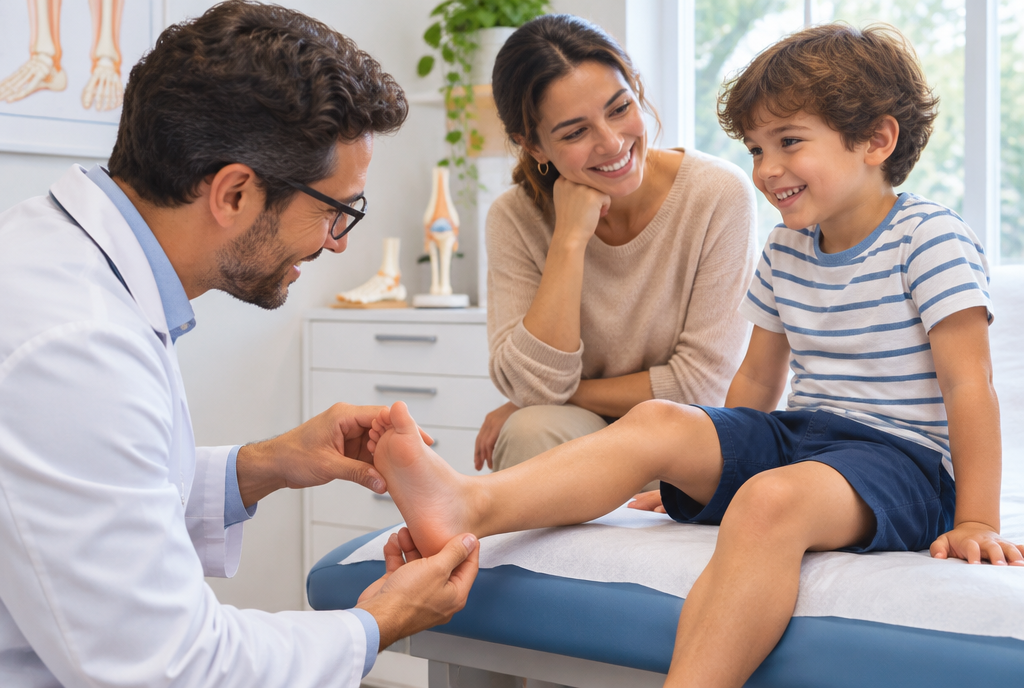
What are flat feet in children?
Flat feet mean the inner arch looks low or flat, and the heel often tilts outwards.2,3,6 In many children the arch flattens on standing but shows when they sit or lift the foot. This is called a flexible flat foot.3 Doctors do not all use the same definition.7
Babies are born with flat feet, and the arch builds up over about ten years.3,5 Flat feet are also common in adults without problems.2 Most flat feet cause no problems,2,3 although some children have pain or trouble with activity.7
Flexible and rigid flat feet
Flexible. The arch shows when the child sits or stands on tiptoe but flattens on standing. This is the most common type.3 If the child is comfortable and active, it is usually a normal variation and needs no treatment.2,3,8 A few become painful, sometimes linked to a tight heel cord (Achilles tendon).3,8
Rigid or painful. The arch stays flat even when sitting or on tiptoe, because the foot is stiff.3 This is less common. It can be linked to problems such as two-foot bones being joined together, which may cause pain in the teenage years.3,9
| What parents notice | Why it may matter | When to book | What the doctor checks |
|---|---|---|---|
| Flat arch, but comfortable, active, both feet alike | Very common and often normal1-3 | Usually not needed | Symptoms, movement, how the foot looks3 |
| Pain that keeps coming back, or a stiff foot | Some flat feet hurt; pain can have other causes3,10 | Book an appointment | Where it hurts, foot movement, need for X-ray3,6 |
| One foot looks different, or getting worse over time | Needs checking for an underlying cause6,9 | Book an appointment | Both feet, changes over time6 |
| Limping, avoiding sport, or shoes wearing out fast | Can go with painful flat feet3,10 | Routine appointment | Walking, movement, shoe wear3,6 |
| Swelling, injury, cannot put weight on the foot, or fever | Points to causes other than the arch3,10 | Urgent same-day care | Full check and any tests needed10 |
None of these means your child has a serious condition.
When should a child be seen?
Watching is usually enough when the foot is flexible, painless and matches the other, and the child is active with no change over time. The whole picture matters more than how the arch looks.3,7 Book a children’s bone and joint (pediatric orthopedic) appointment for lasting or repeated pain, stiffness, one foot looking different, changes over time, limping, or avoiding activities.3,6
How do doctors check?
A doctor asks about when it started, where and when it hurts, injuries and shoes. They check the feet and legs standing, sitting and walking, and how well the foot and ankle move.3,6 X-rays are not needed for every child. They may be used for unusual pain, stiff foot or surgery planning, and never just to confirm a low arch.6 Some joined foot bones need a CT or MRI scan because an X-ray may miss them.6,9
When is treatment needed?
Treatment depends on symptoms and examination, not arch shape alone. Most children with painless flexible flat feet need only watching.3 For sore feet, ordinary insoles may ease pain, and custom insoles have not been shown to work better.3 Exercises make sense when a doctor finds a reason, such as a tight heel cord, not just a low arch.6 Surgery is rarely needed and is considered only when pain continues despite watching and non-surgical care.
Can shoes or insoles permanently correct a child’s arch?
Insoles can help comfort in some children. Changing the arch for good is different, and the evidence suggests they probably do not.
What should parents avoid?
- Using a footprint or photo to diagnose. Measures vary and are not clearly reliable in children.7
- Buying “corrective” products because of advertising. There is no evidence they change outcomes.3,4
- Assuming all pain comes from the arch. Leg pain has many causes.3,10
Before the appointment
Note which foot hurts, where, when, what triggers it, how often, what your child cannot do, and whether things are getting worse. This helps the doctor but does not replace an assessment.
Common questions
Does going barefoot fix flat feet?
Children who grow up barefoot tend to have higher arches, but these studies compare different groups and cannot prove barefoot walking changes one child’s arch.11,12 We found no trials testing it as a treatment.
Can flat feet cause knee or back pain?
Some studies link them, but this does not prove cause. In 95 children aged 8–15, flatter feet went with more knee, hip and back pain, but why is unclear.13
Should my child avoid sport?
Not because of the arch. Decide based on symptoms and how the foot works.3
References
- Pfeiffer M, Kotz R, Ledl T, Hauser G, Sluga M. Prevalence of flat foot in preschool-aged children. Pediatrics. 2006;118(2):634-639. doi:10.1542/peds.2005-2126
- National Health Service. (2025, June 24). Flat feet. NHS. https://www.nhs.uk/conditions/flat-feet/
- Carr JB 2nd, Yang S, Lather LA. Pediatric pes planus: a state-of-the-art review. Pediatrics. 2016;137(3):e20151230. doi:10.1542/peds.2015-1230
- Evans AM, Rome K, Carroll M, Hawke F. Foot orthoses for treating paediatric flat feet. Cochrane Database Syst Rev. 2022;(1):CD006311. doi:10.1002/14651858.CD006311.pub4
- Uden H, Scharfbillig R, Causby R. The typically developing paediatric foot: how flat should it be? A systematic review. J Foot Ankle Res. 2017;10:37. doi:10.1186/s13047-017-0218-1
- Halabchi F, Mazaheri R, Mirshahi M, Abbasian L. Pediatric flexible flatfoot; clinical aspects and algorithmic approach. Iran J Pediatr. 2013;23(3):247-260.
- Banwell HA, Paris ME, Mackintosh S, Williams CM. Paediatric flexible flat foot: how are we measuring it and are we getting it right? A systematic review. J Foot Ankle Res. 2018;11:21. doi:10.1186/s13047-018-0264-3
- Mosca VS. Flexible flatfoot in children and adolescents. J Child Orthop. 2010;4(2):107-121. doi:10.1007/s11832-010-0239-9
- Zhou B, Tang K, Hardy M. Talocalcaneal coalition combined with flatfoot in children: diagnosis and treatment: a review. J Orthop Surg Res. 2014;9:129. doi:10.1186/s13018-014-0129-9
- Sawyer JR, Kapoor M. The limping child: a systematic approach to diagnosis. Am Fam Physician. 2009;79(3):215-224.
- Hollander K, de Villiers JE, Sehner S, et al. Growing-up (habitually) barefoot influences the development of foot and arch morphology in children and adolescents. Sci Rep. 2017;7:8079. doi:10.1038/s41598-017-07868-4
- Rao UB, Joseph B. The influence of footwear on the prevalence of flat foot. A survey of 2300 children. J Bone Joint Surg Br. 1992;74(4):525-527. doi:10.1302/0301-620X.74B4.1624509
- Kothari A, Dixon PC, Stebbins J, Zavatsky AB, Theologis T. Are flexible flat feet associated with proximal joint problems in children? Gait Posture. 2016;45:204-210. doi:10.1016/j.gaitpost.2016.02.008