Sciatica describes a pattern of nerve-related leg symptoms, not a specific structural diagnosis.1,2 A slipped or herniated disc is a structural change in an intervertebral disc that can cause sciatica if it irritates a nearby nerve root.³ Disc changes are common on imaging in people with no symptoms at all,⁴ and sciatica can have causes other than a disc herniation.¹
At a glance
These are not two versions of the same diagnosis: sciatica is a symptom pattern, disc herniation is a structural finding. Not everyone with a herniation has sciatica, and not all sciatica comes from a herniation.1,3,4
| Feature | Sciatica | Slipped/herniated disc |
|---|---|---|
| What it describes | Leg-dominant pain, sometimes with numbness or weakness, in a nerve-root pattern1,2 | Inner disc material bulging beyond its normal outline³ |
| Pain pattern | Buttock/leg pain, often below the knee; back pain usually milder1,5 | No pain in itself — may sit alongside sciatica or cause no symptoms3,4 |
| Causes | Disc herniation, spinal stenosis, other nerve-root irritation1,2 | Age-related and mechanical change; many discs alter shape without ever becoming symptomatic4,6 |
| Assessment | History plus neurological exam (e.g. straight leg raise)1,2 | Identified on imaging; interpreted alongside symptoms3,4 |
| Role of imaging | Not routine; used selectively¹ | Common in symptom-free people, so finding alone doesn’t prove it’s the cause4,6 |
| First-line care | Staying active, self-management¹ | Guided by nerve-root symptoms, not the scan appearance1,3 |
How a disc problem causes sciatica
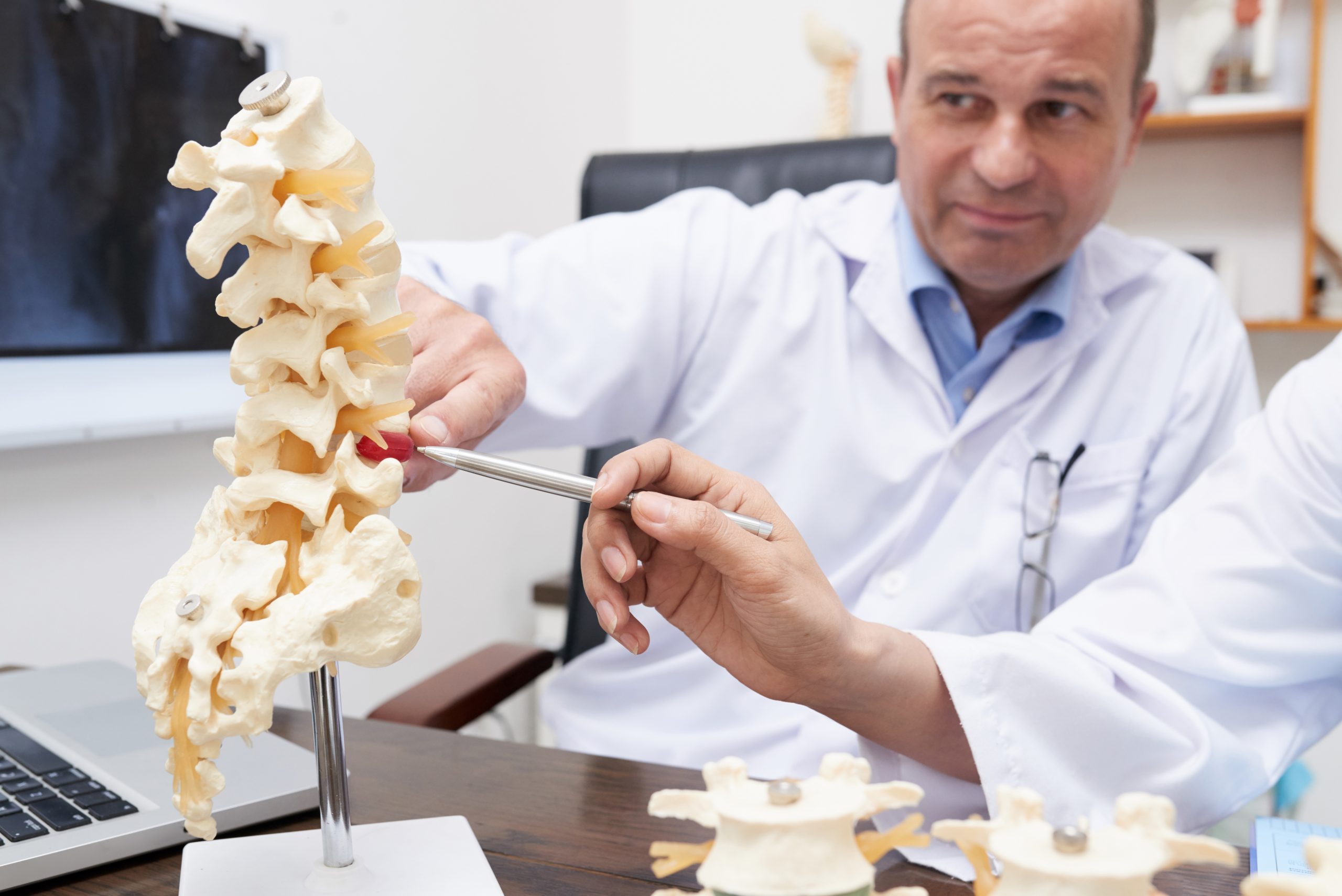
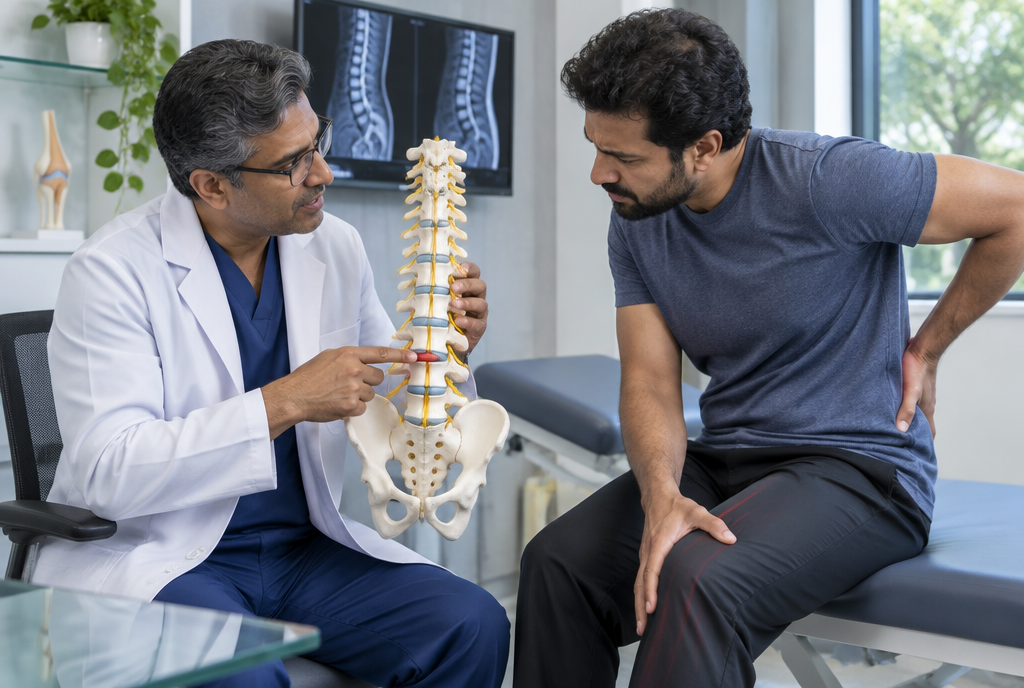
Each disc sits between two vertebrae, with a firmer outer layer around a softer core; a nerve root exits the spinal canal just beside it.³ In a herniation, inner disc material bulges or breaks through the outer layer and can irritate a nearby nerve root through compression and local inflammation, which is why pain can travel from the back into the leg.1,3 A disc is held firmly by ligaments and does not literally “slip”; disc herniation is the more accurate clinical term.³
How symptoms differ
Sciatica typically radiates from the back or buttock into one leg, often below the knee, sometimes with numbness, tingling, or weakness, and is often worsened by sitting, coughing, or sneezing.1,2,5 Not everyone has every feature.
A lumbar disc herniation only causes leg symptoms if it affects a nerve root; some herniations cause only local back discomfort, and many are found incidentally on scans with no symptoms at all.3,4,6 A finding on a scan doesn’t by itself confirm it’s the cause of pain.⁴
A cervical (neck) disc problem irritates nerves supplying the arm and hand, not the leg, so it causes neck/arm symptoms, cervical radiculopathy, and is a distinct condition from sciatica.⁷
Can sciatica happen without a slipped disc?
Yes. Other recognized causes include lumbar spinal stenosis (narrowing around the nerves, more common with age), facet joint or other degenerative changes, and less commonly other conditions affecting a lumbar nerve root.¹ Clinicians consider the most likely cause from the history and examination, not by assumption.1,2
How clinicians investigate leg pain
Clinicians ask about pain location and radiation, onset, aggravating/relieving factors, numbness or weakness, functional impact, and red-flag symptoms.1,2 A focused exam, strength, sensation, reflexes, sometimes a straight leg raise test, supports a nerve-root diagnosis, though no single test confirms a herniation on its own.1,2
Imaging is not automatically needed for sciatica. MRI may be considered for severe, persistent, or worsening symptoms, red flags, or when specialist/surgical treatment is being planned.¹ Even then, disc bulges and degenerative changes are very common in people with no symptoms, one review found disc bulges in around 30% of pain-free 20-year-olds, rising to roughly 84% by age 80.⁴
Is treatment different?
Management depends on severity, duration, neurological findings, and function, not on which term is used.¹ Non-surgical care (staying active, tailored advice) is first-line; evidence for some medicines once widely used for sciatica specifically is limited.¹ If symptoms are severe, persistent, or neurologically significant, options like referral or injections may be discussed.¹ Surgery is not routine. In carefully selected patients with confirmed disc herniation, trials show surgery can bring faster short-term relief than continued conservative care, though outcomes tend to converge over one to two years; it’s considered for persistent, disabling symptoms or significant neurological deficit after specialist assessment — not on imaging alone.8-10
Seek urgent medical attention if you notice:2,5
- Sciatica in both legs at once
- Severe or rapidly worsening leg weakness or numbness
- Numbness around the genitals, inner thighs, or back passage (“saddle” numbness)
- New difficulty urinating, or loss of bladder control
- Loss of bowel sensation or control
These can signal cauda equina syndrome, a rare emergency requiring same-day hospital assessment, since delay raises the risk of permanent nerve damage.2,5 Most sciatica is not an emergency, these features are rare.⁵
Who treats it?
Care usually follows a stepped pathway: GP/primary care for initial assessment,¹ physiotherapy for active management,¹ musculoskeletal/spine specialists for persistent or severe cases,¹ and neurosurgery/spinal surgery when specialist opinion is indicated8-10 — including emergency referral for suspected cauda equina syndrome.²
FAQs
Does every slipped disc cause sciatica?
No — many are symptom-free and only cause sciatica if they affect a nerve root.4,6
Does sciatica always affect one leg?
Usually, yes; both-leg sciatica is uncommon and a red flag.²
Can an MRI prove the cause?
Not alone, findings must be read with the symptoms and exam, since similar changes occur in pain-free people.4,6
Can sciatica improve without surgery?
Yes, for many people, with non-surgical care; timing varies and can’t be guaranteed.1,5
Is walking okay with sciatica?
Guidance generally favors staying active over prolonged rest, though this varies by person.¹
When should I see a spine surgeon?
Usually after specialist assessment for severe, persistent, or neurologically significant symptoms,8-10 or urgently for any red flag above.²
References
- NICE. Low back pain and sciatica in over 16s: assessment and management. NG59. 2016 (updated 2026). nice.org.uk/guidance/ng59
- NICE. Sciatica (lumbar radiculopathy). Clinical Knowledge Summaries. cks.nice.org.uk/topics/sciatica-lumbar-radiculopathy — used for general definition and, in Sections 8/10, cauda equina red flags (see QC note below).
- Jensen RK, Kongsted A, Kjaer P, Koes B. Diagnosis and treatment of sciatica. BMJ. 2019;367:l6273.
- Brinjikji W, Luetmer PH, Comstock B, et al. Systematic literature review of imaging features of spinal degeneration in asymptomatic populations. AJNR Am J Neuroradiol. 2015;36(4):811–816.
- NHS. Sciatica. nhs.uk/conditions/sciatica/
- Brinjikji W, Diehn FE, Jarvik JG, et al. MRI findings of disc degeneration are more prevalent in adults with low back pain than in asymptomatic controls: a systematic review and meta-analysis. AJNR Am J Neuroradiol. 2015;36(12):2394–2399.
- McCartney S, Baskerville R, Blagg S, McCartney D. Cervical radiculopathy and cervical myelopathy: diagnosis and management in primary care. Br J Gen Pract. 2018;68(666):44–46.
- Gibson JNA, Waddell G. Surgical interventions for lumbar disc prolapse. Cochrane Database Syst Rev. 2007;(2):CD001350.
- Jacobs WCH, van Tulder M, Arts M, et al. Surgery versus conservative management of sciatica due to a lumbar herniated disc: a systematic review. Eur Spine J. 2011;20(4):513–522.
- Peul WC, van Houwelingen HC, van den Hout WB, et al. Surgery versus prolonged conservative treatment for sciatica. N Engl J Med. 2007;356(22):2245–2256.